
11. You Are an Artist
A Manifesto

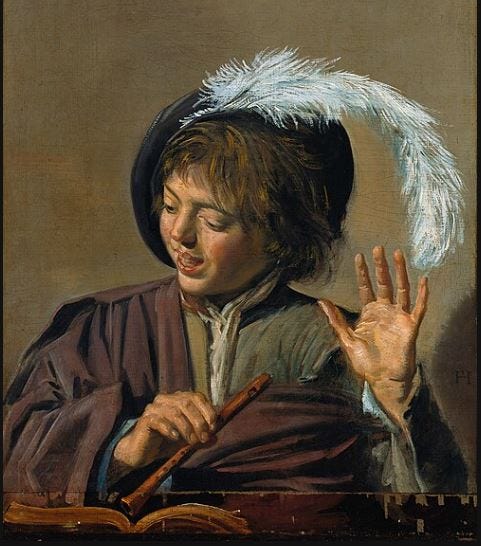
Singing Boy with a Flute, Frans Hals
You are four years old. Your cousin Gina takes you to her children’s choir practice at the Lutheran church in Shoreline. She tells you that her choir director really needs to hear you sing. She says that you are too young but that they should still let you sing with them. They are all big kids, and you feel small and out of place. You stand next to the studio piano that towers over you. You can just see over the keys of the piano, where the choir director sits. All the big kids are circled around you. You hold the music and you are scared. But it is easy—you know that song. The choir director says you can sing with them. Then you feel proud. You are singing with the big kids.
At age seven, taking piano lessons, you don’t practice like you should. At your lesson, playing Beethoven’s Fϋr Elise, you haven’t learned the ending. So, under pressure, you make up your own ending—in the right key with a Dominant to Tonic conclusion that fits very well (though you have, of course, no idea what those things mean or what you have done—you just play what sounds right). Your piano teacher asks if you like to improvise. You say yes, but you think she is just being nice because you haven’t practiced and learned the ending like the music says.
In fourth grade, you are in the “special choir.” That means what it implies: the talented bunch. There is a photo of you doing a flourish at the end of the hat-and-cane dance routine, dipping your hat to the crowd, with the other kids looking at you like “Woah, what are you doing?”
In sixth grade, you have a choice of electives. You walk by the choir room at Marysville Middle School, and they are singing the same song you sang in 5th grade with the special choir. There are very few boys, and they are what you think are “geeks.” You tell your mom that you don’t want to be in choir. And that is the end of it. Then you pursue money, career, success. Your plan is to be a millionaire, and it doesn’t matter how. You make no connection between your talent for music or love of writing and actual life. Actual life means meeting the expectations of someone, everyone, yourself? And those expectations are money and success.
Even though you do nothing to develop your talent, you think singing the national anthem for graduation from high school would be cool, so you audition. You listen to the lifers—kids who live and breathe chorus. Some are okay, most are bad. You sing it better than all of them. The teacher straight-up tells you they would give it to you if you were actually in chorus, but it wouldn’t be fair to the kids who put in the years. You understand. You play the trumpet in the ensemble instead.
You are not encouraged to pursue the arts. There are no singers, dancers, or writers among your family or close friends. Even so, these are your decisions. You think that the arts have nothing to do with real life. Arts are for kids, or leisure diversion—of no value to anyone.
You. Were. Wrong.
You have a chance. You are pulled into musical theater by accident when you join a rock band to find a girlfriend and then take voice lessons. Then you actually get a music degree, just because it’s a way to use your GI bill and it’s fun. Then you have success for a bit, singing in Seattle. But you think you are just lucky, that you don’t really belong there and that your luck will run out. So, when the first baby arrives, you quit musical theater. It’s just not responsible, you think.
You are successful in the corporate world. Very successful. You turn a failing business around, making millions for the owners. Then you climb into the top 5% of earners in corporate America, making a massive impact, optimizing quality, leading people, helping them do their jobs better. It is of incalculable value. But when you hit fifty-five, they discard you, and nobody else will hire you. You pour twenty years of your life-blood into the corporate machine, and it leaves you with exactly—nothing. Nothing but a sacrificed life.
In order to function in that corporate life, you swallow Adderall. It is the only way you can stay focused on a career that is otherwise empty and uninspiring. Years of amphetamine use raises your blood pressure, so you start taking blood pressure medicine at age 45. Your cholesterol starts to climb. You need reading glasses now, probably from staring at a computer screen most of the day. Your body becomes weak, pasty, flabby. You are aging. Sure, you pay your child support and are a very good father. But you are a man without passion. You abandon your authentic self and live life as a shell of a man that your children cannot respect. Had you lived your authentic life, followed your passions, perhaps you would be a father they could respect. But that isn’t what you thought you were supposed to do.
Instead, you lived a mostly dead life when you could have been alive. You could have developed that talent when you were a kid. You could have had a lifetime of dance lessons and not be an uncoordinated “white-guys-can’t-dance” old man. You could have developed your talent for music and singing at an early age when your brain was developing and learning was easy. You could have been in theater, developed your acting ability. You could have spent a fulfilling life connecting with souls and helping people feel more human. Instead, you spent a life becoming less and less human.
And today, those decisions torture me.
At age fifty-nine, I am spending all my energy trying to scrape up what might be left for me of a life that you dismissed—a life of feeling more alive and helping others to feel more alive. My family, who knows me only as a shell of a man, is taken aback. They don’t know what to do with this man. They feel that I have gone off the rails and that they need to prod me back into line. They don’t know that to prod me back to a “responsible” life is as good as pushing me off the edge of a skyscraper.
I will sing. When I sing, it connects people, transcending differences, even of space and time. Composers and poets from other centuries and other continents are connected with musicians and audiences of today. We connect in our joys and pains, in beauty and sorrow, in love and heartbreak—the sacred turbulence of life that is shared by all humanity. We connect where the soul lives and in sharing that connection feel more alive, more human.
I will write. I can only hope that the decades of disregard for my own humanity have left me to appreciate it more and be extraordinarily motivated to share my experience with others, so that someone else might not make the same mistakes. I need to show others the value of art. That art is the way to send your unique value into the world and through that, bring people together. In a world of separation, art is what leads us to where the soul lives, to where we know each other as one.
I will use what is left of my life and talent to bring some humanity back into a world of technology and capitalist drones, to remind people what it is like to feel alive, to be human.