
8. The Pivot
Good Friday

January 2024
Everett, WA
“Yeah, I’m goin’ down. I’m goin’ down, down, down, down, down.”
I was sitting alone in my huge, empty white Suburban, parked at the distribution center and finishing the song I had been working on during the commute: Joe Bonamassa’s “Going Down.” I would just scream it. Lots of rock singers scream and have done it for fifty-plus years. Like Steven Tyler of Aerosmith, Roger Daltrey of The Who, etc. I just needed to learn a new technique, and maybe screaming would break free my elusive top range. I had finally hit a G4 today, and I was excited, so I screamed it out.
“Yeah...”
Shit. That didn’t feel good. What am I doing? I can’t even sing rock-n-roll.
But let me back up a bit. I had left Colorado and moved in with Mom. Then began applying for jobs in Washington. I really wanted to put corporate life behind me, but that probably wasn’t an option. I had begun detailing boats, but the work was just neighbors so far. Not paying the bills. So, I got a job managing a distribution facility in Everett, Washington, at less than half my previous salary. I was also helping to build a blues rock band called “Distilled”
The 21-mile commute to the Distribution Center took a full hour each way. Lovely Everett traffic. But I made use of the time. I spent the morning drive doing vocal exercises, trying to get my voice back. Then, on the drive home, after a quick warm-up, I would work on songs for the band.
As I pulled out onto the highway that morning, I started my warm-up—humming. Mmm, nnn, and nnng—five-note scales from the bottom of my range up to about a C4 and back down. That would get me about halfway to work. Then an ‘a’ vowel. To the top of my range, which still hadn’t made it up to a G4. During my professional career, I had performed a solid D5, seven steps higher. That is a huge difference. It is the difference between a tenor and a baritone. I am a tenor, and two years after having completely lost my voice, I still couldn’t sing higher than a baritone. However, a year before, I was another seven steps lower, so this was progress. Reason for hope. But my voice was different. It didn’t ring like it used to, so I had settled for rock. Back to the adrenaline stage. But even that wasn’t going well.
And then the scream: “Yeah..!”
At the second rehearsal, I had to tell them I had blown out my voice, and I couldn’t sing very much. I wasn’t disappointed. I would just listen to them play. The guitarist and bass player were both masterful with their instruments, it was a joy to listen. But singing in this band just wasn’t doing it for me. They didn’t even listen to my voice. It was just another instrument in the wall of sound. And at this point, I was having to force my voice. It didn’t feel natural. But it was all I could do. I had no voice for opera or even musical theater anymore.
I rested my voice for two weeks after that attempted “Goin’ down” scream and began again. Vocalizing. Practicing. Two hours every day. There had been progress, I kept reminding myself. But it was still far away from the singing that had once felt so thrilling—when my whole body would become music and connect with souls. Every day I practiced with a voice that just didn’t feel like it was part of me. It was a struggle. I had to push, and it wasn’t responding right.
Then I went to get “scoped.” What was going on with my voice? Was singing no longer a reality? Were my vocal cords destroyed? Were they now too old for legitimate singing? Had they atrophied? Did I have lesions, nodules?
I went to the University of Washington Performing Voice Clinic for a comprehensive voice evaluation, which included a laryngeal videostroboscopy. There was a voice “team” in the room there: the doctor, his assistant and a voice coach. I sat in a dentist-like chair, and the doctor began the scope. There is a camera on a stick (a flexible fiber-optic nasopharyngoscope). They stick it up your nose and work it down into your throat to get a video of your vocal cords. The first time I had this done, there were sensations of needing to sneeze and then to vomit. But I was experienced now. I focused on relaxing all the muscles of that passageway.
The assistant asked me to sing some pitches and then sing part of an easy song. I tried to sing “Doctor My Eyes” by Jackson Browne. It was the easiest song I was working on for Distilled, and depressingly, it was still difficult. I was embarrassed. My cheeks warmed. I was sure they were wondering, Why is this guy here wasting our time. Then they asked me to sing something challenging. I started “Che gelida manina” from Puccini’s La Bohème, which I sang at my senior recital. This would show them that I was a real singer. But I couldn’t get through the first phrase.
After the scope, they analyzed the video. The voice coach said that I was creating extreme subglottal pressure with what she called “belly-breathing.” I was filling my lungs with air and forcing that air against my vocal cords with high pressure from a rock-hard stomach of “support.” Bottom line: I was trying to get my voice to work right with sheer muscular force. It made sense. That’s exactly what I was doing. Like anything in life, I thought, you wanted to make something happen, you work. And if you wanted it badly, you worked really hard. Maybe not for singing—at least not like that.
But the more important part to me came from the otolaryngologist. How are my cords?
“They are perfectly healthy. I don’t see any nodules, and there are no lesions. I suspect from your description that you did have lesions. But they are gone now. I also see no signs of aging atrophy.”
My God. This was miraculous. I felt like crying. I had not damaged my voice permanently. This meant I just needed to be patient and keep working.
I got a voice teacher: Dr. Kari Ragan, a world-renowned pedagogist who had written a book on training the voice. She confirmed the “belly-breathing” diagnosis. That first lesson was an epiphany. She helped me relax my breath pressure and I realized at that moment that I wasn’t broken; that a technical adjustment could make a difference. The pushing I had been doing to try to force my voice to work right was actually the problem—not the solution. I had to relearn how to breath! She gave me some tools and techniques for training, and I continued with voice exercises, vocalizing and practicing at least two hours a day, nearly every day. My range continued to advance at the breathtaking pace of one-half step... per... year.
I was still trying, unsuccessfully, to sing rock-and-roll, when I was asked to sing in the Anacortes Lutheran Church choir.
Then, I was asked to sing a solo.
I really couldn’t sing any solo that I used to sing for church, or anything I had sung during my once-upon-a-time career. But I could do this one thing. It was a hymn—“Were You There?” And she wanted it a cappella—no accompaniment. This meant that I could sing it in whatever key I wanted, however I wanted. I could even change the melody if there was something I still couldn’t sing. I could improvise it into anything. It was literally the only version of a “solo” performance that I was capable of.
April 18, 2025
Anacortes, WA
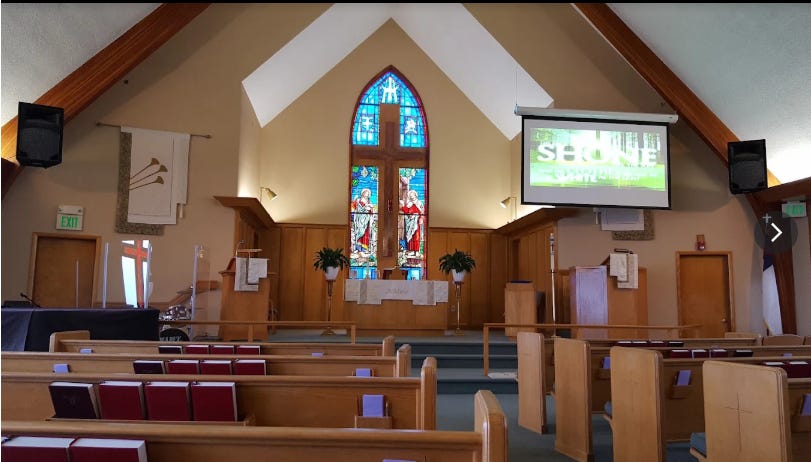
I stood alone in the choir loft at the back of the church above the congregation, looking down at the backs of their heads and resting my hands on the cold brass balustrade. I was nervous. What would my voice do? I told myself that it was fine; I would just improvise the song into whatever my voice could do. The screen at the front of the church said, “Special Music - Danny Markham.” The scripture reading had finished. I was up.
I had decided to add interest to the five verses of the hymn by modulating up a step with each verse. That introduced the problem of my limited range. A cappella, you can’t rely on staying right in key unless you have perfect pitch, which I do not. I knew adrenaline would possibly push me sharp. That made me fearful, because I was already pushing my functional range of a G4.
I began the song. I sang the first verse, modulated up for the second, then again for the third, and my voice broke, so I sang in falsetto. Then halfway through the song, when I was trying to be soft, I lost my breath support, and my voice began breaking again. During practice, I had some great images and subtext in mind, but during this performance, with fear and my voice breaking, much of that preparation just vanished.
In other words, I felt the song was pretty bad.
Later, my choir director would tell me that she had never seen as many of the congregation in tears during her forty years of being at that church. So, with my bad voice, limited range, anxiety, my voice breaking, and the lost characterization, forgotten images and subtext, the song had still moved much of the congregation to tears.
Looking back at my decision to return to real singing, it’s easy to trace it to that day. That solo, on Good Friday. But it occurs to me that it wasn’t just that solo, that day. The Pivot point was much more specific:
I had finished the song and was still standing on the balcony at the back of the church, looking over at the backs of everyone’s heads (which is why I didn’t know so many had teared up until I was told later). I backed away from the rail, receding from a pretty bad performance. I turned around and saw a woman standing in the doorway to the balcony. It was K.C., one of the sopranos in the choir. And she had streams of tears running from both eyes down her face. She was blocking the doorway, and I didn’t know what to say. She looked at me with all earnestness and said, with a cry still in her voice:
“You are amazing!”
I had connected with a soul. Even though my voice felt different, wrong even, this is what it was for. I stepped forward and wrapped my arms around her. I felt her wet tears on my neck and said the only true thing I could think to say.
“No, God is amazing.”
In appreciation for my paid subscribers, the live recording of that performance is below. Just click the play button.
